Building a High-Performance Engineering Portfolio with Next.js
Most personal portfolios are treated as design projects. Colors, animations, and layout tend to dominate the conversation. In practice, a portfolio is an engineering system — one that must balance performance, search visibility, maintainability, and long-term scalability.
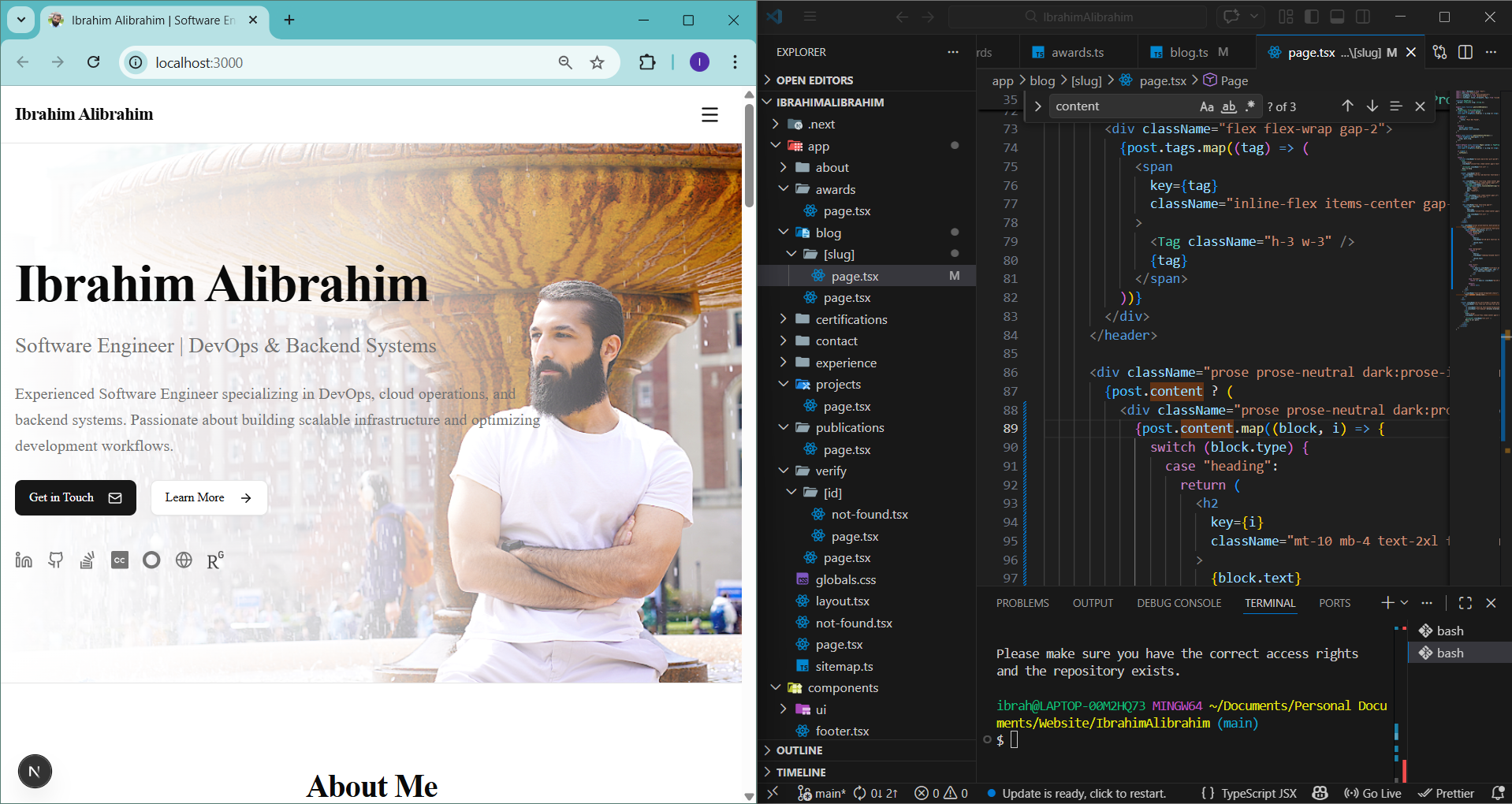
This project was approached with a different mindset. The objective was not to build something visually impressive, but to build something technically correct: a fast, SEO-optimized platform that acts as a canonical identity hub for Ibrahim Alibrahim.
The result is a fully static website, deployed globally, with near-instant load times and a structure designed to scale without introducing unnecessary complexity.
Defining the Constraints Early
Performance and simplicity were treated as hard constraints from the beginning, not goals to be achieved later. This significantly influenced every architectural decision made throughout the project.
- No backend — eliminate unnecessary infrastructure
- Static export — remove server-side latency entirely
- Minimal JavaScript — reduce hydration and runtime cost
- Data-driven architecture — separate content from presentation
By enforcing these constraints early, the system naturally avoided common pitfalls such as over-engineering, performance regressions, and unnecessary dependencies.
Architecture: Designing for Scale Without Complexity
The site is built using Next.js with static export, combined with a strictly data-driven structure. All content is stored in structured JavaScript files and rendered through reusable components using map-based patterns.
This approach ensures that scaling the platform does not require modifying core logic. Adding new experience entries, projects, or article posts is reduced to updating data files only.
- Clear separation between data and UI components
- Reusable component system for consistency
- Predictable rendering patterns across all pages
- Zero reliance on runtime data fetching
Performance as a First-Class Feature
Performance was not treated as an optimization step. It was treated as a core feature of the system. Every design and implementation decision was evaluated against its performance impact.
- Static generation eliminates server response delays
- Reduced JavaScript footprint minimizes execution time
- Careful use of images avoids layout shifts and slow rendering
- Avoidance of heavy animation libraries reduces bundle size
The result is a consistently fast experience, with Lighthouse scores exceeding 95 and load times well under one second.
Engineering for SEO, Not Just Metadata
Search engine optimization is often reduced to adding meta tags. In reality, effective SEO requires structural clarity, consistency, and strong signals across the entire platform.
Each page was designed to be independently indexable, with unique metadata, clean URLs, and clear semantic structure.
- Unique titles and descriptions for every page
- OpenGraph and Twitter metadata for sharing
- Canonical URLs to prevent duplication
- JSON-LD structured data for identity recognition
- Sitemap and robots configuration for crawler guidance
Structured data plays a critical role. By linking all major professional profiles, search engines can establish a strong identity graph and associate all content with a single entity.
Deployment and Infrastructure Simplicity
Infrastructure was intentionally kept minimal. Domains are managed through Cloudflare, while deployment is handled by Vercel using static hosting.
This setup provides global distribution, automatic optimizations, and a zero-maintenance deployment pipeline. Each commit results in a production-ready build without manual intervention.
Challenges and Tradeoffs
Achieving both performance and flexibility required deliberate tradeoffs. One of the primary challenges was working within TailwindCSS constraints, particularly with dynamic class generation.
Dynamic styles had to be refactored into predefined mappings to ensure compatibility with the build process. This added structure at the cost of flexibility, but resulted in a more predictable system.
Visual design also required restraint. Background images, animations, and layered effects were evaluated carefully and often reduced to maintain performance and readability.
SEO introduced its own complexity. Ensuring consistent metadata, correct canonical URLs, and properly structured data required attention to detail across every page.
A System, Not a Page
The final result is not just a portfolio website. It is a structured, scalable system designed to represent a professional identity with clarity and precision.
Features such as the certificate verification system, data-driven rendering, and structured SEO implementation reinforce credibility while remaining simple to maintain.
Conclusion
The key lesson from this project is that simplicity is achieved through control, not reduction. By enforcing constraints early and prioritizing structure, it is possible to build systems that are both high-performing and maintainable.
A personal portfolio, when treated as an engineering system rather than a design exercise, becomes significantly more than a static page. It becomes a long-term asset for credibility, discoverability, and growth.